The T-shirt label “Phalanx Europa,” founded in 2016 by the Austrian Identitarian Movement, promotes a new generation of far-right fashion trends online. Statement T-shirts, which at first glance resemble alternative fashion, use pop culture-inspired lettering and emblems to convey the far-right Identitarian demand for “remigration” and messages such as “Honor, Freedom, Fatherland” or “If that bothers you, I’ll help you pack.” This replaces the far-right dress code—shaved head, bomber jacket, combat boots—which is firmly anchored in the cultural memory and has been regarded for several decades as the prototypical appearance of neo-Nazis. In place of this uniform—which has been associated equally with brutal assaults and racist attacks—a fashionable look has now emerged that attempts to normalize far-right violence through the aesthetic appropriation of pop-cultural and left-wing autonomous styles.
What has contributed to this change, and where can a semiotic investigation within fashion and pop culture be traced in the context of the rise of far-right groups? This trail leads back to the 1990s, when clothing brands were founded—among others—by neo-Nazi officials to spread far-right messages in Germany and Austria. The language of fashion is part of a comprehensive parliamentary and extra-parliamentary modernization movement of the far right in Europe and the U.S. Currently, these groups aim to avoid an easily recognizable appearance in order to be perceived as mainstream. The American sociologist Cynthia Miller-Idriss noted in her study The Extreme Gone Mainstream (Princeton UP 2018)—in which she examined the commercialization and role of right-wing clothing brands in schools and within youth and pop cultures—that this makes it easier to grow and recruit young followers. Pop culture has long been regarded as a space for subversion that offers room for emancipatory potential. Meanwhile, this discursive space appears to be being appropriated by right-wing movements primarily through left-wing “communication guerrilla” strategies. Within the framework of the symposium, the following questions must therefore be explored: What should be done when the established symbols and visual languages within right-wing groups are no longer so clearly recognizable or distinguishable? How can individual codes, clothing, and styling practices be differentiated from the sartorial practices of left-wing autonomous subcultures? How does a Nazi fashion label like Thor Steinar manage to evolve from clothing originally associated with the far right into what appears to be a lifestyle accessory? What role do fascist-like aesthetics and their ironic-affirmative appropriation play within pop culture, fashion, and music? As large segments of the Western political and discursive landscape drift to the right, what does this mean for feminist achievements and gender norms?
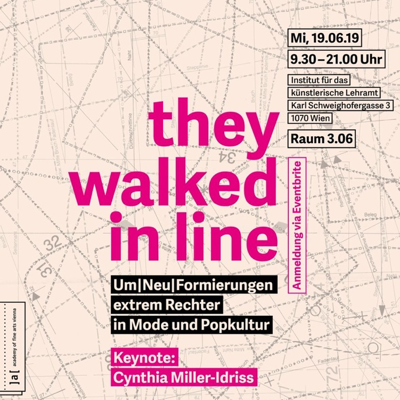
This one-day symposium explores current developments and discourses at the intersection of fashion practices, the so-called “New Right,” and pop culture, and aims to highlight and discuss the latest trends in the field through lectures, workshops, and a panel discussion.
Program Schedule
9:30 – 10:00
Coffee and Registration
10:00 – 10:30
Welcome: Elisabeth Sattler
Introduction: Elke Gaugele, Sarah Held
10:30 – 11:00
Presentation: Michael Bonvalot
Self-Presentation, Visual Language, and Media Strategy of the Neo-Fascist Group “Identitäre” and the Self-Proclaimed “New Right”
11:00 – 11:45
Presentation: Emil Peters, Ulrich Meyer
On the Necessity of a Critical Examination of Thor Steinar
11:45 – 1:00 PM
Keynote: Cynthia Miller-Idriss
Selling Extremism: Fashion, Fascism, and Embodiment
1:00 – 2:00 PM
Lunch break
2:00 – 3:00 PM
Field Report: Uwe Traxler
Nazi Reenactment as a Historical War Game
2:00 PM – 4:00 PM
Workshops
Jerome Trebing
“Return Your Revolt Into Style”? – Fashionable Performances of the Far Right at the Intersection of Media Representation and Subcultural Community-Building.
Emil Meyer, Ulrich Peters
Investigating Thor Steinar
Valerie Lange, Jana Patz
“I Could Be a Nazi Bride, Too.” – The Far-Right Look in Everyday Life: A Personal Experiment
Sarah Held
(Anti)Feminism, Sexism, and Racism as a Toxic Alliance in Far-Right Resentment
Carina Klammer
Return of the Retro-Avant-Garde. Fascist Aesthetics as Reflected in the “New Right”
4:00 – 4:30 PM
Coffee break
4:30 – 6:00 PM
Panel discussion
Moderators: Elke Gaugele, Sarah Held
Jerome Trebing
Carina Klammer
Michael Bonvalot
Emil Peters